Living white paper — updated Q1 2026

From AI Hype to Operational Reality

How Financial Marketers Are Navigating the Most Disruptive Shift in a Generation

in partnership with FINAL UPGRADE AI

About the Report

FMI is a global community and platform dedicated to senior financial services marketing leaders, convening them to share insights, accelerate best practices, and elevate the role of marketing across the sector.

Founded in 2024 by Jacob Howard, former Global Investment Bank Marketing lead at Deutsche Bank and Chair of the Chartered Institute of Marketing's Financial Services Group, FMI now hosts CMO summits in London, New York, Dubai, Toronto, and Singapore, and partners with global forums such as Abu Dhabi Finance Week and the World Media Group.

Throughout 2025, a recurring theme in FMI's discussions throughout Dubai, London, Hong Kong, and New York has been the impact of artificial intelligence.

Collating insights from these global conversations, and in partnership with leading expert Dominique Rose Van-Winther (Final Upgrade AI), FMI has curated a comprehensive paper consolidating the most pressing findings and discourse on AI in financial services marketing.

Final Upgrade AI, through Wealth Upgrade, is a global AI transformation firm led by Chief AI Evangelist Dominique Rose Van-Winther, specializing in helping financial institutions navigate AI adoption and organizational transformation.

Editorial Contributors

Jacob Howard FCIM, Founder, Financial Marketing Insights

Former Global Investment Bank Marketing lead at Deutsche Bank and Chair of the Chartered Institute of Marketing's Financial Services Group, Jacob founded FMI in 2024 and the global community of senior financial services marketers now stretches across financial centres including London, Dubai, Singapore, New York, Riyadh, Toronto, and Abu Dhabi. His work focuses on elevating the role of marketing inside financial institutions and building shared intelligence across the sector. For this white paper, he synthesises insights from FMI's global summits, roundtables, and partner conversations to provide a clear, practical view of AI adoption in financial services.

Dominique Rose Van‑Winther, Founder, Final Upgrade AI

Dominique is an AI strategist advising financial institutions on digital transformation, governance, and marketing innovation. Her work spans multiple continents, helping organisations navigate the intersection of customer experience, regulatory complexity, and emerging technologies. Her contribution to this report focuses on AI maturity, governance, and the operational realities facing marketing teams.

Abdul‑Rahim Osman (ARO), Vice Chair, Regional Head of Partnerships, Middle East, FMI

Abdul brings extensive experience from senior marketing and partnership roles at HSBC, where he led initiatives across the Middle East. At FMI, he oversees regional partnerships and engagement, working closely with CMOs, regulators, and financial institutions. His contribution to this white paper reflects the themes emerging from FMI's Abu Dhabi roundtable and the accelerating pace of AI adoption across Gulf markets.

Foreword

The pace at which AI has moved from strategic aspiration to operational mandate has outrun most marketing teams for financial organisations' ability to respond. The ambition is real. The infrastructure, governance, and human readiness to meet it often are not.

Our insights from Summits in five key financial centres and a range of global discussions conclude that CMOs and senior marketers are all saying the same thing: the noise is deafening, the expectations are rising, and the pressure to "have it figured out" is real. Yet behind closed doors, most teams are still working out how to use AI safely, effectively, and in ways that genuinely improve customer experience and commercial performance.

This white paper — grounded in a multi-level framework and validated through senior marketing roundtables — reveals that the greatest barriers to AI adoption are not technological. They are organisational, operational, and human.

Financial marketers are caught in the middle of a structural contradiction: they are expected to move faster with AI but operate in systems and governance models designed to move slowly. Until organisations address this gap, AI will remain trapped in pilot mode — producing noise rather than value.

“Over the past three years, I have carried out roundtables in Abu Dhabi, strategy sessions in Singapore, and private conversations with CMOs in London, New York, and across the Gulf. Collaborating with FMI on this paper has been an opportunity to bring that field intelligence into a broader, structured conversation. The four realities that emerge across this report — Personal, Functional, Enterprise, and Customer — reflect what financial marketing organisations are genuinely grappling with: the Fear Flip that has reversed professional anxiety overnight, the Shadow AI quietly filling the Enterprise Enablement Gap, the compliance friction erasing efficiency gains before they reach a dashboard, and the Pilot Purgatory that stalls initiative through structural failure rather than lack of ambition. These patterns surface across regions and organisational types, and they deserve the honest examination this paper gives them.”

— Dominique Rose Van‑Winther, CEO, Final Upgrade AI

This paper outlines what's breaking, what's emerging, and what leaders must do next to move from AI ambition to AI advantage.

Jacob Howard, Founder, FMI
Executive Summary

~/fmi/findings $ 30–40% time savings

Reported from automating structured tasks at the Singapore summit

~/fmi/maturity $ Level 1–2

Where most financial services organisations remain on the AI maturity scale

~/fmi/barriers $ Pilot Purgatory

Most AI initiatives stall not from lack of ambition, but from governance friction and organisational inertia

AI has moved from the edges of financial services marketing to the centre of every conversation. Our insights from Summits in five key financial centres and a range of global discussions conclude that CMOs and senior marketers are all saying the same thing: the noise is deafening, the expectations are rising, and the pressure to 'have it figured out' is real. Yet behind closed doors, most teams are still working out how to use AI safely, effectively, and in ways that genuinely improve customer experience and commercial performance.

This white paper — grounded in a multi-level framework and validated through senior marketing roundtables — reveals that the greatest barriers to AI adoption are not technological. They are organisational, operational, and human.

Financial marketers are caught in the middle of a structural contradiction: they are expected to move faster with AI but operate in systems and governance models designed to move slowly. Until organisations address this gap, AI will remain trapped in pilot mode — producing noise rather than value.

Want to Read the Full Report?

Unlock the complete white paper — including the FMI AI Maturity Framework, regional analysis, playbook, and implementation guide.

We respect your privacy. No spam, ever.

1. The State of AI in Financial Services Marketing

Across every FMI summit, roundtable, and podcast conversation over the past year, one pattern has become impossible to ignore: AI is no longer a standalone topic. It is the subtext of the entire financial marketing agenda. Whether the discussion is about customer experience, brand, content, analytics, or digital transformation, AI now sits underneath every strategic decision and every operational challenge.

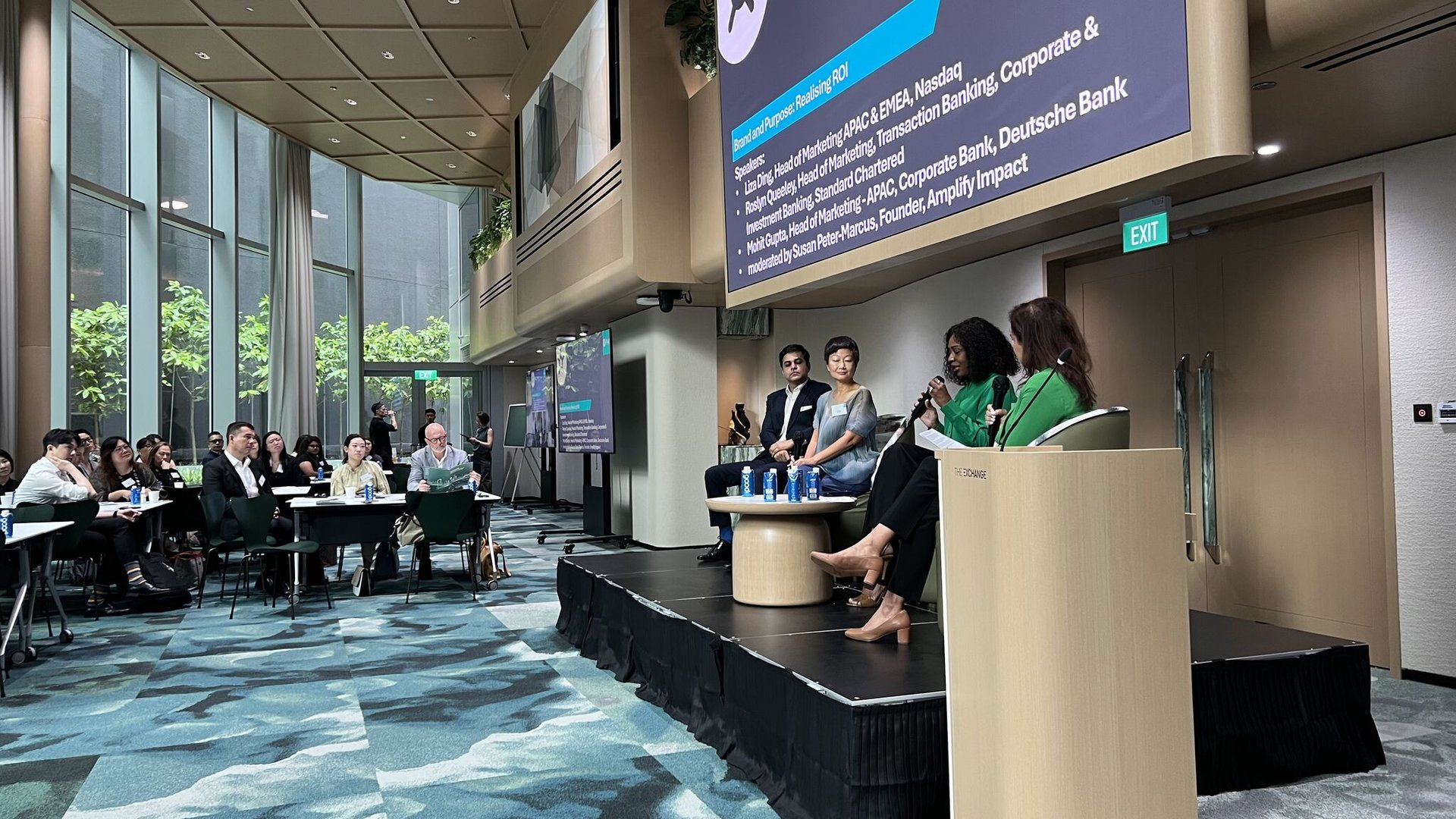
APAC Financial Services Marketing Leaders' Summit, Singapore

Singapore

From Hype to Operational Reality

Enterprise AI isn't consumer AI. Compliance, legal safeguards, and brand integrity must be baked in.

At the APAC Financial Services Marketing Leaders' Summit in Singapore, the conversation around AI was strikingly pragmatic. Speakers highlighted productivity gains — 30–40% time savings from automating structured tasks — and the rise of AI agents and digital workforces. Perhaps the most urgent theme was Generative Engine Optimization (GEO). Singapore set the tone: AI is here, it is operational, and it is reshaping the fundamentals of marketing execution.

FMI Financial Services Marketing Leaders' Summit, UAE

Middle East

Acceleration, Ambition, and AI-Native Thinking

AI adoption is a board-level priority across the region. The ambition is real — but operating models haven't caught up.

The Abu Dhabi roundtable made one thing clear: financial marketers are no longer debating whether AI matters. Digital-first banks are moving quickly, while established institutions invest in governance, capability building, and experimentation. Common themes: AI Centres of Excellence, active exploration of AI agents, rising concern about GEO, and a willingness to invest and move at pace. The emotional tone was one of ambition and urgency — a desire to lead rather than follow.

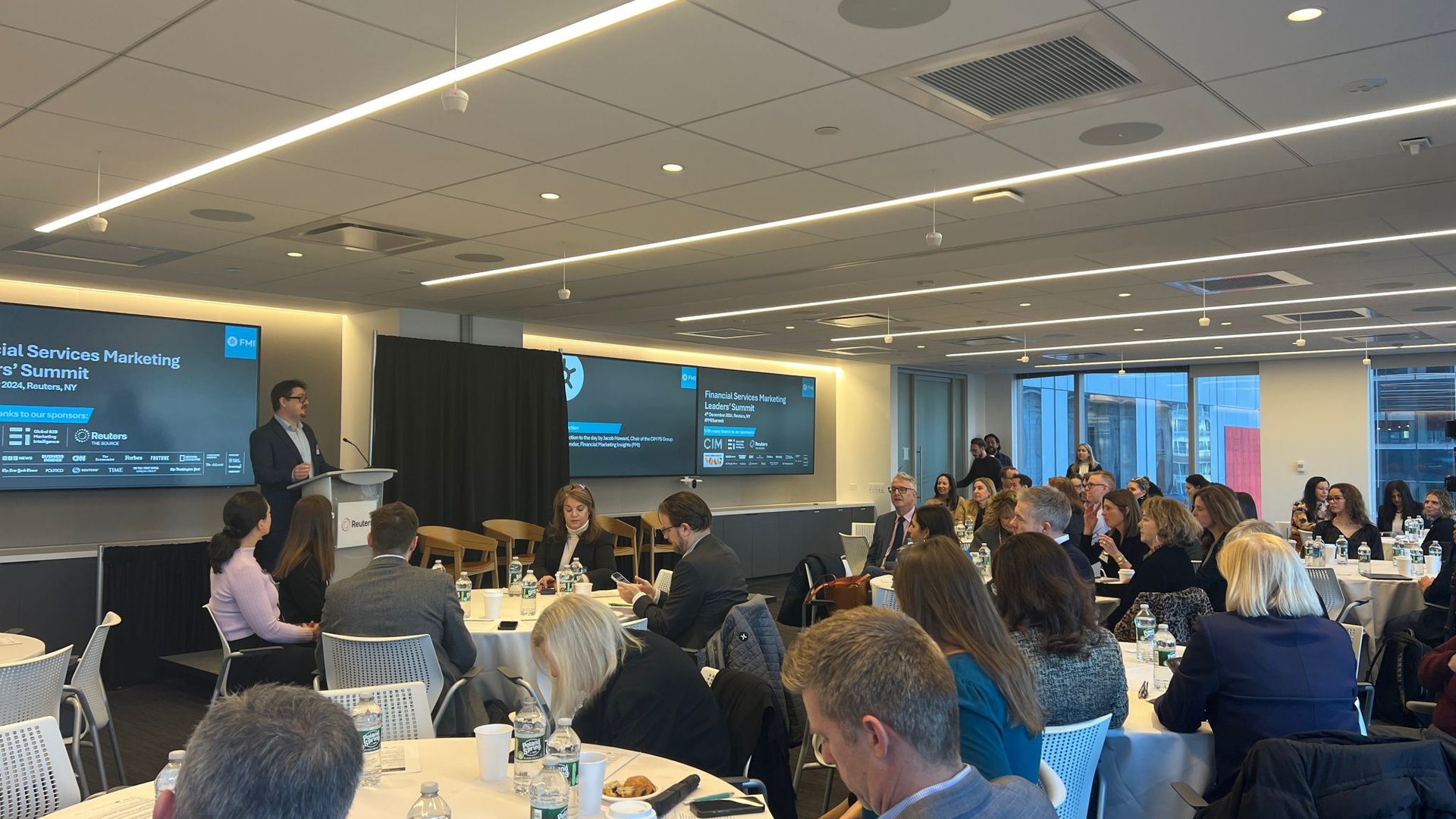
Financial Services Marketing Leaders' Summit at Reuters, New York

North America

Pressure, Noise, and the Demand for Clarity

Everyone feels like they're supposed to have an AI strategy, but nobody agrees on what that actually means.

At the Americas Financial Services Marketing Leaders' Summit at Reuters in New York, AI surfaced in every session — even those that had nothing to do with AI. The emotional truth was candid: 'We're all experimenting, but none of us feel like we're doing it properly.' GEO was a quiet but persistent concern. Compliance challenges were front of mind. North American marketers are experimenting, but many feel they lack structure, governance, and clarity.

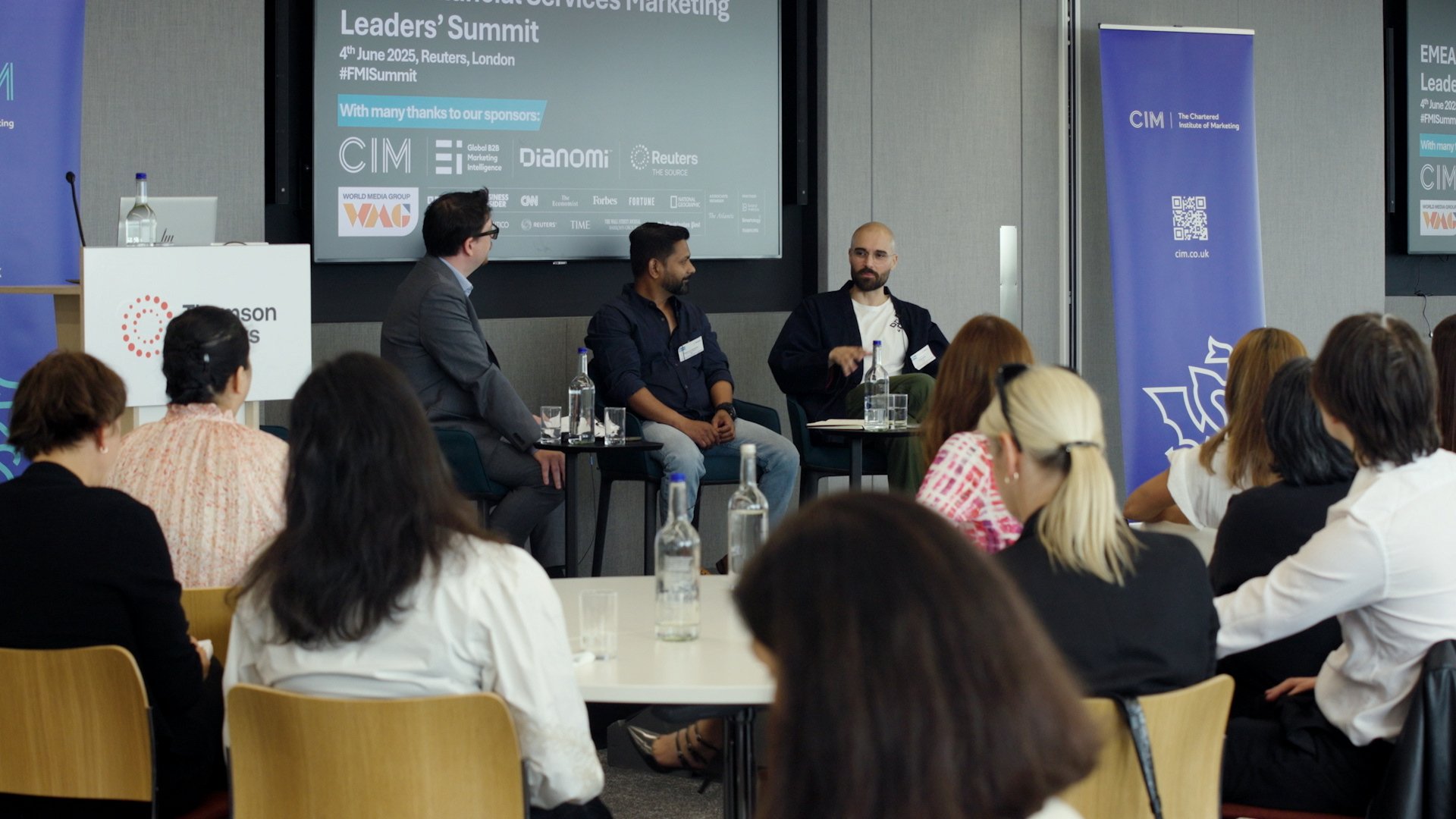
EMEA Financial Services Marketing Leaders' Summit at Reuters, London

Europe

Caution, Governance, and Creative Integrity

AI is powerful — but creativity remains central. Strategy must not be sacrificed for speed.

The EMEA Summit at Reuters in London revealed a different energy. The audience was particularly vocal about protecting creativity and strategic discipline. The prevailing view was pragmatic: lead with customer experience, buy rather than build, and use AI to empower small teams without compromising brand integrity. Humans must stay firmly in the loop.

The Global Pattern: Shared Challenges, Shared Momentum

01

AI is everywhere, even when it's not the topic

02

Compliance and governance are the universal blockers

03

GEO and AI-driven discoverability are rising fast

04

Marketers want frameworks, not hype

05

Teams are shrinking, but expectations are rising

06

Creativity and human judgment remain essential

07

Centres of Excellence are emerging across all regions

08

The pressure to implement is real — but clear use cases remain hard to come by

"Before, the fear was: if you use AI, you're in trouble. Now the fear has completely inverted. If you don't use AI, you're in trouble."

— Senior marketing leader, global financial institution

2. What Senior Marketers Actually Want

Across FMI's summits, roundtables, and podcast conversations, senior financial services marketers have been strikingly aligned in what they need from AI — and equally clear about what they do not.

Practical, Operational Clarity

Many describe feeling overwhelmed by noise, hype, and contradictory advice. Marketers are looking for grounded guidance: where to start, how to scale, how to work with compliance, and how to measure impact.

Guardrails and Governance

They want AI that is safe, compliant, brand-aligned, and auditable.

Better Insights, Delivered Faster

The old model of waiting for annual analyst reports has been replaced by a desire for real-time intelligence.

AI Must Enhance Creativity, Not Replace It

Across every region, marketers are united on this point. Creativity remains the currency of marketing.

GEO (Generative Engine Optimization)

A growing area of concern and curiosity. While few talk about it publicly, many admit privately that they are worried about how generative engines will reshape discoverability.

Future of Teams and Skills

Marketers know their teams are changing — there is real anxiety about the disappearance of entry-level roles and the challenge of upskilling teams at pace.

What Marketers Do Not Want

They are exhausted by hype, futurism, and generic vendor claims. They want clarity, honesty, realism, and outcomes — not noise.

"I just want to leave because I don't want to be on this sinking ship that isn't using tech. I can use it personally, but there's nothing going on at work. It's literally this feeling of — I don't want to work in a company that's so stale."

— Senior professional, top-tier global bank

In short, senior financial services marketers want AI that is practical, governed, brand-safe, insight-rich, creatively empowering, and operationally realistic. And they want partners who understand the complexity of financial services — not vendors who treat AI as a magic wand.

3. The FMI AI Maturity Framework

Across every FMI summit, roundtable, and podcast conversation, one truth has become clear: financial services marketers are not all starting from the same place. But almost everyone is asking the same question: "What does good look like?"

The FMI AI Maturity Framework answers that question. It provides a simple, practical way for CMOs and marketing leaders to understand where they are today, what the next step looks like, and how to move forward with confidence.

Clarity

A shared language for AI maturity across the organisation

Direction

A clear path from experimentation to implementation

Confidence

Reassurance that progress is possible, even in a regulated environment

1

AI-Curious

Early Exploration Without Structure

Most organisations begin here. AI is being tested in pockets — a few individuals experimenting, a team trialling a writing assistant.

Read more

At this stage: AI use is ad hoc and ungoverned; compliance is nervous; outputs vary wildly; teams lack shared understanding; there is no clear strategy or ownership.

Leaders at this level often describe a sense of uncertainty: they know they need to move, but they don't yet know how. As one senior marketer told us, "We're all experimenting, but none of us feel like we're doing it properly."

Priority: Build literacy and reduce fear. Organisations need to understand what AI can and cannot do, and begin to establish the foundations for safe experimentation.

2

AI-Enabled

Human-Led, AI-Assisted

This is where most financial services organisations sit today. AI accelerates existing workflows. Humans still generate the work, but AI helps refine, check, or scale it.

Read more

Typical patterns include: humans write first, AI edits; AI is used for research, summaries, and first drafts; teams begin to define guardrails; compliance starts to engage; early governance structures emerge; brand voice and tone are fed into tools.

One experienced practitioner described this stage as "Human Generation, AI Review." It is a meaningful step forward — but still fundamentally human-led.

Priority: Move from scattered experimentation to structured enablement — building governance, defining use cases, and ensuring AI supports brand integrity rather than diluting it.

3

AI-Integrated

Hybrid Workflows and Shared Ownership

AI becomes part of the operating model rather than an add-on. Workflows are redesigned so that humans and AI collaborate, each doing what they do best.

Read more

This is where organisations begin to see real efficiency gains: AI generates multiple options, humans choose and refine; content, research, and insights are co-created; teams use AI to personalise at scale; compliance and marketing work together on governance; Centres of Excellence begin to form.

Leaders at this stage talk about AI as a partner rather than a tool. One guest described it as "human in the loop — your intelligence, creativity, and reasoning guiding the machine."

Priority: Orchestration — aligning people, processes, and platforms so AI can operate safely and consistently across the organisation.

4

AI-First

AI-Generated, Human-Directed

Only a small number of organisations have reached this stage — but it is where the industry is heading. A fundamental shift in workflow logic.

Read more

At Level 4: AI generates first, humans refine; teams orchestrate agents rather than execute tasks; workflows are automated end-to-end; content, insights, and journeys are dynamically created; governance is embedded into the tools themselves; brand integrity is maintained through structured guardrails.

One senior leader described the future as "humans orchestrating maybe a hundred different agents instead of managing a 50-person division." This is not science fiction — it is already happening in pockets across the industry.

Priority: Scale — ensuring AI-first workflows are safe, compliant, and commercially effective across the entire organisation.

4. The Four Realities Marketers Must Navigate

AI is reshaping financial services marketing at every layer of the organisation — not only in technology stacks or workflows, but in the psychology of marketers, the expectations of leadership, the constraints of compliance, and the experiences of customers.

These realities are not sequential stages. They are the lived conditions inside which AI adoption happens — emotional, operational, organisational, and customer-facing.

The Human Experience of AI

The Fear Flip Shadow AI The Acceptability Shift Skill Development Anxiety

At the personal level, AI adoption is defined less by technology and more by psychology. Marketers are living through what Final Upgrade describes as The Fear Flip — the dominant emotion has inverted from "don't touch AI" to "if you don't use AI, you're in professional trouble."

This shift is intensified by Shadow AI — the widespread, unspoken reality that marketers are using personal ChatGPT, Claude, and Perplexity accounts because enterprise tools are unavailable or too restricted. The Enterprise Enablement Gap leaves them with little choice.

Layered on top is The Acceptability Shift — the emerging norms around whether using AI is "cheating" or simply smart. And beneath it all sits Skill Development Anxiety — marketers don't know which skills matter, how fast the landscape will change, or whether the tools they learn today will be obsolete tomorrow.

"AI platforms are blocked on all work devices. Senior executives are switching Apple Store regions to download apps, using personal devices and VPNs, and transferring outputs to work email. Your people are already using AI — the question is whether they are doing it with governance and best practices, or secretly, on their phones, between meetings."

— Senior communications executive, global financial institution
ChallengePractical ResponseWhy It Works in FS
The Fear FlipMake AI use an explicit expectationRemoves stigma; reduces emotional burden
Shadow AIProvide sanctioned AI tools and internal sandboxesReduces data-leak risk; closes the enablement gap
The Acceptability ShiftPublish clear "acceptable use" normsEliminates ambiguity; protects teams
Skill Development AnxietyOffer role-specific AI upskilling pathwaysEnsures training is relevant; supports career progression

The Operational Truth Inside Marketing Teams

Marketing–Compliance Friction Workflow Redesign Brand Voice at Scale ROI Measurement Void

If the personal reality is psychological, the functional reality is operational — where AI collides with the daily mechanics of marketing work.

The most persistent tension is Marketing–Compliance Friction. AI promises speed, but compliance often erases the gains. Review cycles generate thousands of comments annually, with assets requiring multiple rounds of revision.

This friction is amplified by Workflow Redesign Uncertainty — AI doesn't fit neatly into existing processes. Then comes Brand Voice at Scale — AI can generate content at extraordinary volume, but it often misses the nuance and emotional intelligence that define a financial brand. Many teams face an ROI Measurement Void — they cannot measure AI ROI in a way leadership finds credible.

"Competitor research across seven banks. Social listening across platforms. Three structural creative options. Full website copy with facts and calls to action. All fact-checked. Completed in a single session. The reaction from the executive in the room: 'Oh my God. Now I understand how you can do the job of five people.'"

— Field observation, AI capability session with a senior communications team, major financial institution
ChallengePractical ResponseWhy It Works in FS
Marketing–Compliance FrictionCo-create prompt libraries and review checklists with ComplianceReduces rework; accelerates approvals
Workflow Redesign UncertaintyRedesign workflows around AI rather than bolting AI onto legacy processesPrevents bottlenecks; clarifies handoffs
Brand Voice at ScaleBuild AI-ready brand voice systems (tone libraries, examples, guardrails)Improves "right-first-time" output
ROI Measurement VoidMeasure AI impact at the task level (e.g., time saved per asset)Creates credible, defensible ROI
Role Restructuring FearsDefine evolving roles (AI director, AI editor, AI validator)Reduces uncertainty; clarifies responsibilities

The Organisational Constraints and Enablers

Top-Down vs Bottom-Up Pilot Purgatory Leadership AI Literacy Legacy Integration

Marketing cannot adopt AI in isolation. The enterprise context — leadership, governance, data, systems, investment — determines whether AI becomes a strategic capability or remains stuck in pilot mode.

A widespread tension is Top-Down vs Bottom-Up Confusion — executives issue AI mandates without clear guidance, while individual marketers experiment from the ground up. The result is two parallel AI movements that rarely meet.

This feeds directly into Pilot Purgatory — where AI pilots fail to scale due to unclear ownership, insufficient governance, or lack of enterprise-grade platforms. Underlying all of this is Leadership AI Literacy — boards and executives set AI strategy without always understanding the technology or its risks.

ChallengePractical ResponseWhy It Works in FS
Top-Down vs Bottom-Up ConfusionEstablish cross-functional AI councilsAligns decisions; unblocks adoption
Pilot PurgatoryShift investment from isolated pilots to scalable platformsMoves AI from experimentation to enterprise value
Leadership AI Literacy GapsProvide executive-level AI briefings on risk and governanceEnsures leaders can set realistic strategy
Legacy System IntegrationPrioritise data readiness: cleaning, structuring, accessibilityEnables safe, scalable AI
Agentic AI DeploymentStart with constrained, supervised agents before scaling autonomyBalances innovation with regulatory expectations

The External Expectations Shaping AI Adoption

Rising Expectations Trust Demands Privacy GEO Discoverability

The final reality is the one closest to the customer — and often the most misunderstood.

Customers expect personalisation, speed, and relevance. They expect seamless journeys. They expect brands to understand their needs. But they also expect accuracy, security, and human judgment — especially in financial services.

AI raises expectations on both sides: customers want better experiences, regulators want stronger controls, competitors are moving faster, and generative engines are reshaping discoverability. The customer reality is simple: AI can enhance experience, but only if it is deployed with clarity, governance, and respect for the emotional weight of financial decisions.

ChallengePractical ResponseWhy It Works in FS
Rising Expectations for PersonalisationUse AI to tailor journeys with human oversight for sensitive decisionsBalances relevance with trust
Accuracy + Trust DemandsImplement human-in-the-loop validation for customer-facing AI outputsProtects brand credibility
Privacy + Data SensitivityAdopt transparent data-use policies and consent-driven personalisationAligns with regulatory expectations
GEO DiscoverabilityStructure content for LLMs: factual, modular, Q&A-driven, citation-richEnsures visibility in AI-mediated search
Seamless JourneysIntegrate AI across channels with consistent tone and logicReduces friction; strengthens loyalty

5. Generative Engine Optimization (GEO) — The New Battleground for Discoverability

Generative engines are quietly rewriting the rules of how customers find, evaluate, and choose financial brands. This shift is not incremental. It is structural. And for FS marketers — whose products are complex, regulated, and trust-dependent — the implications are profound.

The Collapse of Traditional Search

Search is no longer a list of blue links. Increasingly, it is a single, synthesised answer generated by an AI model. This shift is particularly disruptive for financial services because FS journeys begin with questions, not products; FS decisions rely on trust and clarity; and FS brands depend heavily on search visibility.

The result is a collapse of the old discoverability model. Brands are no longer competing for rankings — they are competing for representation inside generative systems.

How LLMs Interpret Brands

Generative engines do not behave like search engines. They summarise your brand based on detected patterns, synthesise information from multiple sources, compress your identity into a few sentences, prioritise clarity, consistency, and authority, and fill gaps with probabilistic inference — which can lead to hallucination.

This means your brand is no longer what you publish. It is what the model understands about what you publish.

If your content is inconsistent, the model will flatten it. If your messaging is vague, the model will guess. If your brand is indistinct, the model will merge you with competitors. If your information is outdated, the model will hallucinate to fill the gaps.

The GEO Imperative for Financial Services

Accuracy becomes existential

A hallucinated claim about a financial product is not a minor error — it is a conduct risk, a regulatory breach, and a customer-harm event.

Authority becomes algorithmic

LLMs privilege brands that are consistent, factual, and well-structured. Authority is no longer earned through backlinks — it is earned through clarity.

Distinctiveness becomes survival

If your brand sounds like everyone else, the model will treat you like everyone else. Generative engines compress sameness.

Safety becomes non-negotiable

FS brands must ensure that generative engines do not misrepresent products, exaggerate benefits, or omit critical disclaimers.

What High-Performing Teams Do

GEO ChallengePractical ResponseWhy It Matters in FS
LLM hallucinationProvide structured, factual, machine-readable contentReduces misinterpretation; protects against regulatory breaches
Loss of brand voiceBuild LLM-ready brand narratives with consistent tone and proof pointsEnsures accurate and distinctive representation
Reduced visibilityOptimise for generative engines — clarity over keywords, structure over volumeProtects discoverability as search behaviour shifts
Regulatory exposureImplement human-in-the-loop validation for AI-mediated interactionsPrevents misleading claims
Fragmented contentConsolidate content into authoritative, up-to-date sourcesReduces risk of outdated information being surfaced

The Strategic Shift

GEO marks a fundamental shift in how brands are discovered, understood, and chosen. In a GEO world, the strategic question for FS marketers becomes: "How do we ensure generative engines understand us well enough to represent us accurately, distinctively, and safely?" The brands that answer this question early will define the next decade of financial marketing.

6. The New Playbook for Marketing Leadership

Across FMI's recent summits, senior marketers increasingly describe brand not as a set of assets, but as the operating system for growth — the logic layer that aligns teams, governs execution, and enables scale in an AI-driven environment.

Brand as a System

Reduces Friction

Removes the burden of explaining who you are before you can explain how you help.

Reduces Risk

Eliminates contradictory messages across teams and channels.

🗣

Reduces Debate

Gives teams a shared language so everyone starts from the same foundation.

Reduces Waste

Turns one idea into many expressions without reinventing the wheel.

In a world where products are commoditised and buyers are overwhelmed, a system becomes the signal in the noise.

Brand as the Operating System for Growth

An operating system is not a marketing framework. It is the logic that holds the organisation together — the architecture that ensures every interaction reinforces the same identity and the same value.

It is what allows AI to amplify the brand rather than distort it. Critically, it is what allows the organisation to scale without breaking.

The Leadership Mandate

From
  • Communications
  • Storytelling
  • Campaigns
  • Making marketing visible
To
  • Coherence
  • Orchestration
  • Governance
  • Making marketing indispensable

If brand is now the operating system, then marketing leadership becomes organisational leadership.

The First 100 Days

01

Clarity

Define the narrative — what the organisation stands for and the value it creates.

02

Coherence

Codify the system — design, tone, content architecture, and machine-readable structures.

03

Alignment

Get sales, product, compliance, and regions working from one blueprint.

04

Confidence

Build the plumbing that allows AI, GEO, and human creativity to work together.

The Long View

An operating system is not a project. It is a discipline.

It requires continuous refinement, governance, listening, and curiosity. The brands that treat their operating system as a living asset will be the ones that grow, earn trust, and remain distinctive in a world where sameness is only a prompt away.

The Playbook: Operationalising the Operating System

The new marketing operating system is not a theoretical construct. It is a practical, buildable framework. This section distils the essential moves — the minimum viable architecture — that turns strategy into capability and capability into growth.

The Six Components

01

Narrative

The source code of the brand — a single, coherent mental model

02

System

Design, tone, content architecture, templates, sales enablement

03

Alignment

Sales, product, compliance, risk, regions working from one blueprint

04

Instrumentation

Short-term indicators + long-cycle commercial validation

05

Governance

Guardrails for AI, content, brand, GEO, and sales enablement

06

Evolution

Continuous refinement and adaptation

01

Codify the Narrative

The source code of the brand

Every operating system begins with a single source of truth. The narrative defines what the organisation stands for, the value it creates, the problems it solves, and the language it uses.

Without this clarity, everything else fragments.

02

Build the System

Scale, consistency, and recognisability

Design language
Tone of voice
Content architecture
Templates & sales enablement
Machine-readable structures for generative engines

A strong system removes ambiguity, accelerates production, and protects the brand from dilution.

03

Align the Organisation

Alignment is the multiplier

Sales — use the same narrative
Product — reflect the brand's promise
Compliance & Risk — co-create guardrails
Regions — adapt without breaking coherence
04

Instrument the System

From cost centre to growth engine

Short-term Indicators
  • Trust scores
  • Earlier RFP inclusion
  • Increased consideration
Long-cycle Validation
  • Revenue contribution
  • Share of wallet
  • Retention metrics
05

Govern the System

The mechanism that allows scale without risk

AI use — acceptable use guidelines
Content — accuracy and consistency
Brand — distinctiveness
GEO — machine-readable clarity
Sales enablement — prevent drift

Governance is not bureaucracy — it is the mechanism that allows the system to scale without risk.

06

Evolve the System

A living discipline

An operating system is never finished. The most successful FS marketing teams treat it as a living discipline — something they tune, test, and strengthen over time.

What "Good" Looks Like in Practice

Narrative
Legacy Multiple messages, inconsistent positioning
OS One clear mental model used across teams
Content
Legacy Ad-hoc assets, reactive production
OS Structured, modular, machine-readable architecture
Sales
Legacy Fragmented decks and materials
OS Unified, narrative-aligned, friction-reducing tools
Governance
Legacy Reactive, compliance-only
OS Proactive, co-created guardrails across AI, content, brand
Measurement
Legacy Attribution battles
OS Two-horizon instrumentation tied to revenue and trust
AI Use
Legacy Productivity hacks
OS Integrated, governed workflows aligned to the system

7. Conclusion

Across FMI's global summits, podcasts, roundtables, and community conversations — and reinforced by Final Upgrade's findings and field intelligence — a clear pattern has emerged. Financial services marketing is undergoing a profound shift. Not a shift defined by new channels or new tactics, but by a deeper transformation in how marketing creates value, earns trust, and operates inside increasingly complex organisations.

The organisations that will lead in this new age are the ones building marketing not as a set of disconnected activities, but as an intelligent system — a system that unifies narrative, design, content, governance, and AI into a coherent operating model.

This white paper brings together the lived experience of hundreds of FS marketers across regions and disciplines. Together, these inputs reveal a clear blueprint: codify the narrative, build the system, align the organisation, instrument the impact, govern the work, and evolve continuously.

Standing still is no longer neutral. As AI accelerates complexity and compresses advantage, the absence of a coherent marketing operating system becomes a liability.

But this paper is not a static publication. It is a living document — a shared, evolving operating manual for the global FMI community. As we travel across markets, convene new conversations, test emerging practices, and learn from the marketers shaping the future, we will continue to refine and expand this work.

The age of intelligent marketing is not a destination. It is a discipline — one we will build together, one conversation at a time.

Download the Full Report

Get the complete white paper delivered to your inbox — including the full FMI AI Maturity Framework, regional analysis, and implementation playbook.